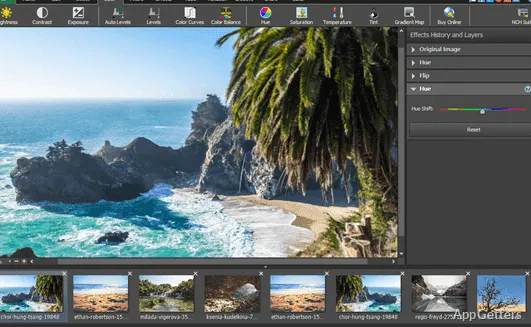
Need to crop a photo, correct its color, or resize it for a project? PhotoPad Image Editor brings those edits together with retouching tools, filters, and options for making collages and other photo-based designs.
Photo corrections and retouching
PhotoPad includes direct controls for cropping, rotating, flipping, straightening, and changing image dimensions. Brightness, contrast, exposure, color balance, and levels adjustments address common lighting and color problems. Preset filters and effects include sepia, grayscale, vignette, oil paint, and cartoon styles.
For localized cleanup, touch-up tools target blemishes and red-eye, while noise reduction and sharpening address image quality. The Remove Object tool lets you brush over a distraction in a photo. Regional Effects can apply a filter to a selected area, so an adjustment need not affect the whole picture.
Collages and image projects
The Collage tool arranges several photos in preset layouts or a freeform composition. Choose a background color or pattern, then add text to finish the design. Captions, borders, frames, clipart, and annotations provide additional ways to prepare an image for a card, post, or presentation.
PhotoPad also includes tools for making calendars, greeting cards, contact sheets, and passport photos. Double exposure combines images with adjustable transparency for a photo montage; HDR creation merges photos taken at different exposures.
Effects, layers, and image formats
Edits and effects appear in a layers list, where existing effects can be reordered or adjusted and layer visibility can be toggled to compare an edit. The program also supports opacity adjustments for layers.
PhotoPad opens the usual formats, among them JPG, PNG, GIF, TIFF and BMP, plus camera RAW photos. Image resizing includes a super-resolution option, and Auto-Colorize tints old monochrome pictures. Text and censor tools cover common finishing tasks such as adding a caption or obscuring part of an image.
Pros
- Crop, rotate, flip, straighten, and resize images
- Retouch blemishes and remove red-eye with dedicated tools
- Combine pictures in preset or freeform collage layouts
- Open JPG, GIF, PNG, TIFF, BMP, and RAW images
System requirements: Windows 7, Windows 8, Windows 8.1, Windows 10, Windows 11
Can PhotoPad make a collage from several photos?
Yes. The Collage tool offers preset layouts and a freeform layout, plus a choice of background and text.
Which image formats can PhotoPad open?
It supports JPG, GIF, PNG, TIFF, BMP, RAW, and other popular image formats.
Can I remove an unwanted object from a photo?
Yes. Brush over the unwanted area with the Remove Object tool to erase the distraction.