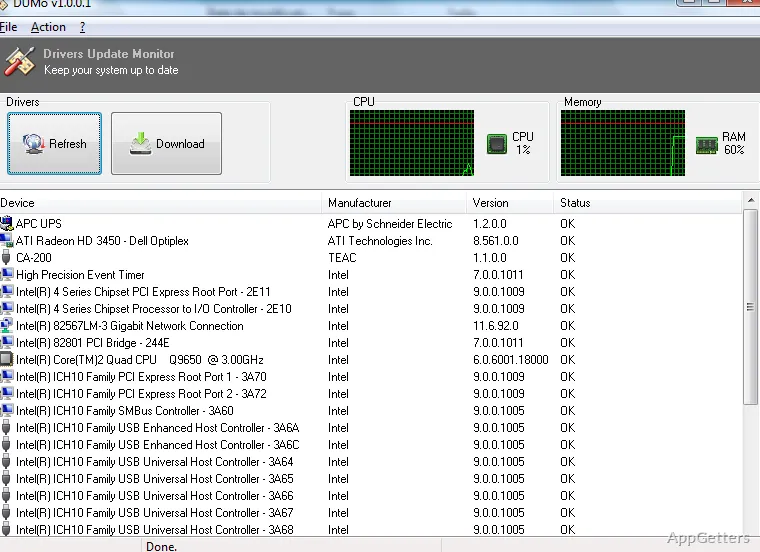
One of those annoying things about Windows is that a huge part of driver updates is often forgotten until you really get down to a hardware issue. Sound cards stop working, graphics glitches, network fails, and even hardware incompatibilities are all symptoms of not having the right drivers. What it does is detect hardware drivers and update their availability. It also keeps the user updated with the update progress status, pretty much like a monitoring dashboard. Users who want a simplified status overview without having to surf multiple vendor sites will be well served by the drill-down centralization of the DUMo software.
Just the Basics on Extra Hassle
Keeping or even upgrading your drivers becomes a doddle with DUMo. Once installed, it uses several scanning methods, one of which is pretty good at generally detecting hardware, to create a full list of all the hardware drivers on the user’s system, along with their version numbers and update status.
This simple functionality makes it very user-friendly, even for newbies, but there might still be a few glimmers of doubt for the less tech-savvy ones when confronted with speeding up or slowing down the hardware drivers. Such distinctions are required, as in actual fact, there are many different situations when an updated driver could fail to provide the best system operation or stability.
Great Aid While Troubleshooting and Upgrading Hardware
DUMo can be really helpful when users experience problems with their devices or when they are upgrading their hardware. Sometimes there are drivers that will not be affected by Windows updates, or which may even lead to bugs in a system. Trying to remember which driver works best with which device is just humanly impossible. So DUMo can help users in identifying outdated drivers, thus saving huge amounts of time when analyzing and troubleshooting.
Meanwhile, technicians and more experienced users can benefit from it as a rapid reviewing tool, too, since it delivers, at a glance, a very comprehensive outlook on the status of drivers. Nonetheless, the advice regarding the software is that it still needs close examination, as one should not randomly update all the drivers. On the other hand, some prefer to download their drivers directly from the websites of the hardware manufacturers. Therefore, DUMo is basically a monitoring and simple report-producing tool, and that’s it, not a full-blown independent auto-updater.
Lightweight, No Interference
That said, running it on a Windows system is a breeze, and the scanning process might be finished in a jiffy. IIt also does not support the heavy background operations that are typical of large-scale system maintenance applications. Top-level ones, for example, especially when used on very old equipment. This makes it suitable as a one-off use tool rather than a tool for constant monitoring and excessive use.
In addition, being so single-minded is also a plus for the software. This is in great contrast to the ubiquitous “PC optimization” suites. They have everything working together, from registry cleaners and startup managers to drivers. But DUMo is focused on driver visibility only. That lesser focus has made the app more loyal and easier to manage.
Even though this is so, the user’s knowledge or awareness still has a big part to play. This affects the software’s usefulness. Beginners who are totally clueless about driver management will definitely be required to look up certain updates before proceeding. There is still the incompatibility risk. This comes about due to the fact that the software does not completely get rid of that risk with incorrectly installed drivers.
Where DUMo Best Serves Windows Systems
The best property of DUMo is that it gives users a clearer understanding of the driver status of their systems. It does this without requiring them to find and visit all hardware vendors’ websites one by one. Its simplicity makes it the app that most home users with old PCs will likely benefit from. Students with laptops and technicians with multiple systems will also benefit. It is all about the ease and the kinds of visibility that it gives, with little to no automation features. These seem to be the hallmark of the software.
By assisting in the review of driver information, most users will probably become more aware of hardware maintenance needs. That is where the software really makes a difference. It does not overwhelm users with unnecessary tools or background operations. Users who know their way around Windows will find DUMo very useful for driver monitoring. It is a lightweight utility for routine system care and troubleshooting.