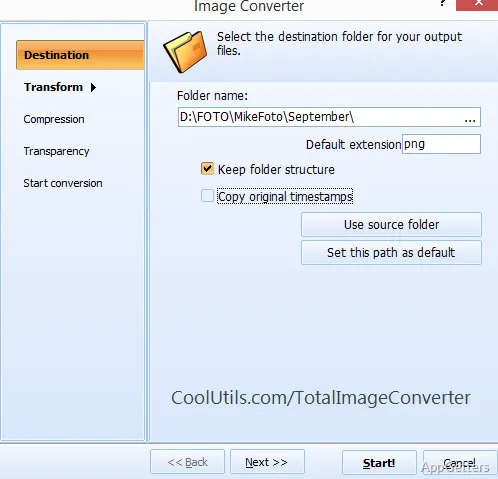
When a folder contains TIFF scans, camera RAW files, and web graphics that need a common format, batch conversion avoids handling each image separately. Total Image Converter can convert image collections and apply changes such as resizing, cropping, or rotation during the workflow.
From image folders to consistent output
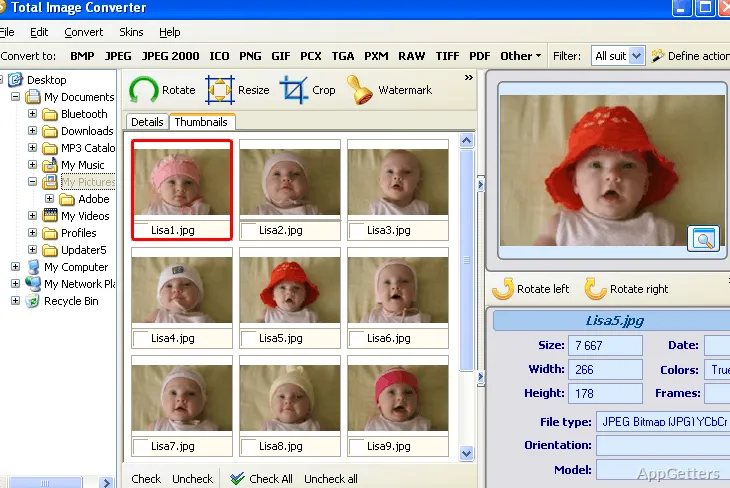
The file browser presents images as thumbnails or as a detailed list, and a preview panel can show an individual file at full size. Select the items to convert, choose an output format, and set the options for the batch.
Supported inputs include common formats such as JPEG, PNG, BMP, and TIFF, along with RAW camera files, PSD, PCX, PCD, TGA, and WebP. Output choices include formats such as JPEG, PNG, TIFF, PDF, GIF, JPEG 2000, and ICO.
Conversion adjustments
Image changes can be combined with format conversion, so a batch can be resized, cropped, or rotated as it is processed. Color-space settings include CMYK-to-RGB conversion, and DPI can be adjusted for output.
- Add text watermarks in an output file’s header or footer.
- Apply a frame to images in a batch.
- Set color space for converted images.
Can it create PDFs from image files?
Yes. PDF is an available output format for image conversion. PDF settings include user permissions and password protection; the program also supports adding a digital signature to PDF output.
Repeatable conversion workflows
The command-line interface allows conversion tasks to be run from scripts. This is suited to recurring jobs where the same format and processing options need to be applied to image files without selecting each batch through the graphical interface.
Conversions run on the PC, and the software also supports multi-threaded processing. That combination suits large collections such as scanned TIFFs that need to be converted to JPEG.
Pros
- Batch conversion covers TIFF, RAW, PSD, WebP, and other formats
- Resize, crop, and rotate images during conversion
- Add text watermarks, frames, or color-space changes to batches
- Command-line controls support scripted conversion
System requirements: Windows 7, Windows 8, Windows 10, Windows 11
Can Total Image Converter convert RAW camera photos?
Yes. It supports many RAW formats, including CR2, NEF, PEF, RAF, ORF, and NRW.
Can I resize or rotate images while converting them?
Yes. Resizing and rotation are available alongside format conversion; cropping is also supported.
Can conversions be automated?
Yes. The command-line interface supports conversion through scripts.